"All good things are wild and free." --Henry David Thoreau

Wednesday, January 30, 2013

Welcome, 2013!

Spiral walk at Starr King Open Space at the end of 2012

It's a beautiful day in January, almost the last day of the month but the sun is shining and the first fuzzy head of purple ceanothus in my yard is blooming and attracting bees. Hummingbirds drink sugar water from my plastic gourds, and raccoons keep digging up my bulbs, chewing their innards and spewing the leftovers around the yard. Everything is full of life, but I've been neglecting Hill Babies, which is a blog dedicated to exploring the San Francisco Bay Area.

Last year was great: large group walks, many postings, and some great opportunities, like getting the chance to write for Bay Nature magazine. So why have I been remiss in keeping this blog for the past couple months?

 I'm pregnant, with twins to boot! 

I have been ecstatic, and love the idea of twins. The doctors believe they are identical girls. But by growing so much more quickly than with my first pregnancy, and being nauseous throughout the first trimester, my desire to walk was greatly curbed.

Also, external events impinged upon me--housing issues that are now resolved, and the adrenaline of the holiday season leaving me, like after ingesting any stimulant, feeling tired in its aftermath.

Those things paled in comparison to what happened last week.

At my 18th week check-up at UCSF's Prenatal Diagnostic Center, just this past Thursday, the doctors scared me with a terrible prognosis. They said my twin identical girls might be developing a serious disease called twin-to-twin-transfusion syndrome. It looked grave, that one baby seemed unable to urinate properly. I might need surgery for the best odds of their survival.

The doctors said I'd have to return to the hospital, but to new and different departments, for serious tests after the weekend.
Scouring the internet in the interim was a lesson in sadness and frustration.  In the four days between the bad news and a second battery of tests that would determine if I'd go into laser fetal surgery (or abort, because the babies would die otherwise in utero), I tried anything that might help, especially protein shakes and bed rest.

I even got down on my knees and prayed: please let these babies live and be healthy, please protect them, blessed be. 

I asked help from God, the Goddess, and the spirit of my father who died when I was a baby. I asked the babies themselves to be healthy, to overcome this and to survive.
By Sunday, I was mentally prepared for fetal laser surgery. That was my choice, and my husband's. We had hope that everything would be okay. The invasive treatment was risky, but it also had great statistical odds of at least one baby surviving, and I was holding out for two.

On Monday, my husband and I drove across the city to UCSF's Fetal Treatment Center, one of four of these kind of places in all of the United States. We were on-time for our 7:45 appointment and already dreading the day. I'd be tested---or the babies would--through ultrasounds and echo-cardiograms for nine hours.

Marshall watched the babies move around the ultrasound screen for the first time. They lay in yin and yang positions, curled against each other when they weren't moving around. Tiny hands and feet, a butt, then two. A strong white femur. A nose on each.

"Oh my god," Marshall said, "Did I see one of them pee?" He said it looked like swirls of smoke in the amniotic fluid, and the radiologist laughed, saying yes, that was urination.

Up until now, Marshall has been busy working when I've had my appointments, and it was poignant that on this grave day, the day before the expected laser surgery, that he felt closer to these babies than ever before.

Why was the radiologist, Dr. Rebecca Smith-Bindman, still smiling as she swept the ultrasound probe across my stomach? Finally, she could barely contain the good news: she didn't think the babies had TTTS anymore. She told us to go downstairs to the Fetal Treatment Center. There, a perinatologist and director of the center, Dr. Larry Rand, also kept smiling.

"Your babies don't have TTTS," he confirmed. "You are not a candidate for laser surgery."

I felt an incredible lightening of spirit, and Marshall was thinking hard, a smile on his face.

Dr. Rand moved animatedly before his whiteboard, using different colored pens to illustrate his words, and all the while it seemed to me he was dancing. He explained that the new ultrasounds showed the babies share a lucky blood vessel, an artery to artery connection, through their placenta.

The artery-to-artery connection in my placenta was discovered that day, and it appeared to have worked like a check-valve over the agonizing weekend. It stabilized blood pressure between the twins, and in my case, the discrepancy between the two (214 grams of weight in the littler one, and 269 grams in the bigger one), was just not enough difference to send me packing.

In simpler language, one baby weighs 8 ounces and the other is 9--on a popular baby website, the average weight of a fetus at 19 weeks is 8.5 ounces.

We talked and talked, and I took notes. Yes, he could and should bring students in to see the next ultrasounds to learn how to detect this artery-to-artery connection (more doctors need to know about how to find this life-saving check-valve). Yes, I would return to the Fetal Treatment Center every two weeks to monitor the babies.

I told him that on the internet there is all sort of anecdotal evidence from mothers saying protein drinks and bed rest helps TTTS (this translates to meaning this past weekend I have been guzzling bottles of gritty vanilla-flavored Boost and Ensure, and being very physically inactive). The doctor said eat real sources of protein, like meat, not shakes. As for circulation, you want mild exercise, not bed-rest (at least in my case).

So I'd been wondering if I would stop doing monthly walks for Hill Babies, though the last one on Sign Hill in November brought 75 people. I would go on hiatus. In fact, I was starting to dislike the prospect of keeping up a blog--why write about walks if I'd be on my back during bed-rest?

I'm ready to write, and I'm ready to walk!

The truth is, whether babies have TTTS or not, going outside and into the sun, on a gentle walk, is some of the best medicine. That's an intuitive declaration on my part, but I wouldn't be surprised if doctors agreed. And for parents who already have children, like me with my three-year-old, it just isn't fair to keep her from the open-ended play found in natural areas, open spaces, preserves, beaches, and parks. Though we live in a city, we are surrounded by nature, and as mammals we really need to be outside more often.

I think there is power in visualizing everything will be okay. Though I might be walking on eggshells for the next four months, what with my need for ongoing tests, I will walk outside and imagine these babies are absorbing sunshine and getting good circulation that will help them develop and be healthy.

So welcome 2013, welcome all you little babies, children, and adults! May we meet on a walk some time soon.

--Jessica


Tuesday, November 13, 2012

SPECIAL TRAVEL POST: PETROGLYPHS and MORE ON THE BIG ISLAND OF HAWAI'I


TWENTY THOUSAND PETROGLYPHS

Pu'u Loa Petroglyph field is a 1.4 mile round-trip walk on the Big Island of Hawaii, and it seems perfectly fine for a little kid, especially on an overcast day, such as it was this past September when the nuclear family visited the Volcanoes National Park
Little G Beans was eager to get out of the rental car we'd driven down the Chain of Craters Road, and my husband and I could understand how frustrating it must've been as we oohed and aahed at the amazing lava fields outside the windows while Little G, restrained by a five-point harness of a baby seat, could only swivel her head and kick her legs. Once we got out at the trailhead to Pu'u Loa, the Beans took off down the gravel and lava rock trail and didn't look back. 
Goddess Pele. Painting by Herb Kane
Pu’u Loa, or “long hill,” is the name of the petroglyph field located between the blue sea and the steep cliff face of Holei Pali. The Hawaiians revered the Pu’u Loa site as a place to bury a baby’s umbilical cord, which was a common ritual to bestow a long life for the newborn.
Talk about a unique hiking experience! We went up and down and all around lava rock, amazing looking stuff: big thick cords, softly sloping pancakes, rippled as a washboard, crunchy looking like granola. The biggest surprise is that our three-year-old loved walking it by herself, and she only fell down once. (An overcast sky and the approach of sunset helped.)

The elevated bridge above 20,000 petroglyphs
This is no small potatoes petroglyph field, but 20,000 strong images. And of that sum, 16,000 petroglyphs are concentric circles or holes, an image associated with the umbilical cord. 
An elevated wooden walkway rings around the main fields (and reminds me of a science fiction story—Asimov?—about visitors going back to Neolithic times and being cautioned to stay on the walkway and touch nothing, but some fool grabs at a butterfly…). Bringing a child on a hike here  has a feeling like connecting the past to the present.
Along the way, ferns and even noni trees, with fruit smelling of Limburger cheese, eked out a living in the cracks of the lava. The ancient Hawaiians planted micro crops of food like yams in these fissures so that people might traverse this rough terrain and eat along the way. I'm guessing they planted the noni fruit, which is edible and medicinal. Genevieve was interested in the fruit, especially its incredible stinky cheese smell. 
"Petroglyph Maker" by Herb Kane

*
AT THE END OF THE ROAD
The end of the road. Credit: livingwilderness.com
After Pu’u Loa, we drove to the end of the Chain of Craters Road where it reached the sea. We ogled at a beautiful sea arch, and then continued by foot down the final stretch of road, though the sun was setting and we were all hungry. 

      A quarter mile down this road (cars are made to park by a ranger's office), a relatively recent lava flow covered the way. Night was falling, so our trek across the lava was short, though a ranger passed us with a group of people carrying flashlights, for down here, a bit further on, one could actually walk to a vista point to see a red ribbon of lava gushing into the sea. 

The end of the road

*
CAMPING NEAR VOLCANO NATIONAL PARK
Highly recommended: cabins at Namakani Paio
Inside the N.P. cabin
 There are so many things to explore at Volcanoes National Park, including 150 miles of trails, that to do even a modest exploration with a child means spending the night close by. Staying at Hilo or Kona, the two main cities on the island, is just too far. One interesting experience is to visit these sights early in the morning before the sun heats up the black lava rocks of the calderas.

Five miles from the entrance to the park is Namakani Paio Campground with both camping and cabins. The A-frame bungalows ($55/night) are awesome, private and cozy, and clean. Each has two bunks and a queen sized bed, linens and comforters (it gets chilly at night), barbecue grills, your own table and benches, and close by is a bathroom with hot showers. Keys and details are arranged directly through Volcano House, right in the park.

            Other options for places to stay are Volcano House, built in the Victorian era on the edge of Kilauea Caldera, impressive to say the least. Expect prices to be expensive. There is also the Kilauea Military Camp, actually a hotel and a dining hall, available to any guest with even a thin military connection.
Pepeiao Cabin. Credit: nps.org

            Experienced hikers—probably without children unless they are fit teenagers—have the option of various cabins in remote areas that are accessed only after a long hike, like Pu’u’ula’ula Cabin on the Mauna Loa Trail up the second largest mountain on the island, or Pepeiao Cabin near the sea in the Ka’u Desert Wilderness, options that are not for beginners or little ones (yet interesting to imagine).
   

        *
RELEVANT INFORMATION

Kids Activities in Volcanoes Nat'l Park http://www.nps.gov/havo/forkids/index.htm
Hawai’i Volcanoes National Park  www.nps.gov/havo
Hawai’i Pacific Parks Association  www.hawaiipacificparks.org
Friends of Hawai’i Volcanoes National Park   www.fhvnp.org
*
PHOTO ALBUM
Pu'u Loa Petroglyph hike
How the Hawaiians survived en route to Pu'u Loa, which seem so far from food and water.
Relaxing on ribbons of pa'hoe'hoe lava
Snacks outside the cabin at Namakani Paio Campground
Sea arch at the end of the road
Lava flowed this deep across the end of the road. 

Monday, November 5, 2012

Next Group Hike: SIGN HILL, SOUTH SAN FRANCISCO

Looking south from Sign Hill
Credit: Friends of Sign Hill
For some odd reason it seems Sign Hill is a place many Bay Area people have never explored. How often have you looked at those letters on the flank of a hill, reading SOUTH SAN FRANCISCO THE INDUSTRIAL CITY, as you zoom up 101 towards San Francisco? 

If you'd like to explore this large and somewhat wild city park, which is also a rare grassland habitat with endangered animals, then join me on a kid-friendly hike later this month.
On Ridge Trail looking north at San Bruno Mountain

When: Sunday November 25th, 2012  10 am to 12 noon, drizzle or shine.

Letters Trail
What: This is the sixth group hike for adults and kids I'll have led this year. We'll traverse two miles in about two hours. Bring what you like, but I recommend lunch, snacks, and water. A camera and binoculars would enhance your experience as the views are incredible, and there is wildlife here, always. We'll take Ridge Trail to Letters Trail to Seubert, and end up on Ridge Trail. Most of the walk is mellow, though Seubert is uphill and with switchbacks.

I'm pleased to announce  Loretta Brooks and Chuck Heimstadt, local activists and naturalists, will join us. They're a treasure trove of information about the flora and fauna, and were instrumental in putting Sign Hill "on the map." They'll join as fellow hikers and casual conversationalists. (There's a chance a couple more local activists will join...keep posted!)
 Ridgeview/Stonegate entrance

Where: Meet at the parking lot at the end of Ridgeview Court in South San Francisco. Coming from San Francisco on the 101, exit onto 425C "South San Francisco. Turn right onto Sister Cities Boulevard, turn left at Stonegate Drive, and proceed uphill onto Ridgeview Court until you reach the parking lot at the end of the street and a sign reading "SIGN HILL PARK."

Ridge Trail
The Kid Factor: My three-year-old walked the planned route just fine. We brought a backpack to carry her, but she was fighting like a wildcat when we tried to load her. So she walked, stubborn as a teenager, and loved it. We're not racing, ever, so don't worry if you aren't much of a hiker. Come because this is an amazing series of trails to explore for adults and kids, right in the middle of the frenetic Bay Area. Though Ridge Trail is stroller-friendly, the rest of the hike is not--so use a backpack if your child is very young or a baby.

WhyWhy do these hikes instead of just doing it with the nuclear family? Simply to be around more like-minded adults while my kid can be around kids. It's about having fun the old-fashioned way. Previous group hikes this year have all been in San Francisco: McLaren Park, Bayview Hill, Visitacion Valley Greenway, Candlestick State Recreation Area, and a Heron's Head and India Basin combination hike.

Cheers,
Jessica

jericahahn (at) hotmail.com
Hawk roosting on Sign Hill


For more information about Sign Hill Park, please visit:
 Friends of Sign Hill (friendsofsignhill.com)
San Bruno Mountain Watch (mountainwatch.org)

On Sign Hill, looking north at San Bruno Mountain


Tuesday, October 30, 2012

HILL BABIES SPECIAL: HIKING KILAUEA IKI , or CROSSING MORDOR WITH A THREE-YEAR-OLD

HIKING KILAUEA IKI , or... 
The faint trail across Kilauea Iki in Volcanoes National Park. Credit: Hawaiigaga.com


CROSSING MORDOR 
WITH A THREE-YEAR-OLD

On our recent visit to the Big Island of Hawai’i, my geology-loving husband was intrigued at the sight of tiny toy-like hikers crawling across the black floor of Kilauea Iki crater, as we stood with our three-year-old on the uppermost edge of a massive volcanic crater in Volcanoes National Park. Try to imagine it: several hundred feet deep, two and a half miles wide, and about half a mile wide, like Satan’s dirty bathtub with all the water gone. However, where we stood, Kilauea Iki Overlook on the Crater Rim Drive, a frenetic road for tourists to quickly gather the mind-blowing sights of this national park, it seemed like only special people got to hike here.
I admit, the thin grey trail across the caldera seemed pretty cool. Then my husband and I looked down at our daughter, playing with pebbles beside tourists snapping photos. 
“G-Beans,” we said, addressing her by nickname, “wanna go down there?”
Taking her lack of protestation as a positive sign (and boy were we delusional), we decided that yes, we’d enter Kilauea Iki the next morning. An informational placard at Kilauea Iki Overlook warned that the descent into the crater was 400 feet (122 m), the height of a 40-story skyscraper. For city folks, that's small potatoes.
      There was a recommended hike of four miles (6.4 km) that took one into the crater, across it, up the opposite side, and along the precipitous edge. It looked great, but we decided it was a hike intended for older kids and adults. 
      Ahh, my husband and I sighed. Just the other day we had driven halfway up Mauna Kea mountain to see the world-renowned astronomical observatories, only to be rebuffed by a ranger who said we couldn't take a child to the top because of the lack of oxygen. But in 12 years, sure, she could go. 

        Here we were, at another great exploratory opportunity on the Big Island. We stood in the shade of tropical trees, looking wistfully down. Perhaps because that blazing sun was out of our eyes, we could think straight. Our wits hadn't melted out of our brains. Yet. 
We decided that the next morning (note how we thought it would nice and cool in the morning, just like in San Francisco), our nuclear family would take the switchback trail dropping off the parking lot by Thurston Lava Tube, hang out on the crater floor for a few minutes, ogle the lava plateau, and go back up the way we came. Easy peezy. 
Would we cross the plateau with a three-year-old? It looked tempting, but no way, Jose.
We’re responsible parents. Sure we like hiking, but are we fifteen-year-olds in the bodies of thirty-eight-year-olds, capable of hijacking a toddler across a volcanic crater?

Pu'u Pua'i, ground zero of Kilauea Iki. Credit: wikipedia


*
The girl who blazed trails.
            The next morning, the ranger at the parking lot thought our kid could make the whole hike.
           “Sure, she can,” she hooted at my question about toddlers hiking across Kilauea Iki. “Just bring plenty of water.” 
            We grabbed hats, sunscreen, and a long-sleeved shirt for the kid. Long pants too (on her), our thought process simple: sun protection. We wore sandals, except the kid, who had closed-toe Mary Janes. A couple who had just finished their hike must’ve thought we were nuts, and they insisted on giving us their official trail guide.
            And so we dropped over the edge of the caldera.
The downhill trail was gorgeous—long switchbacks under a towering canopy of rain forest trees and foliage, full of fragrant kahili ginger and the sound of Hawaiian songbirds. Four hundred feet below the trailhead, we reached the crater floor.
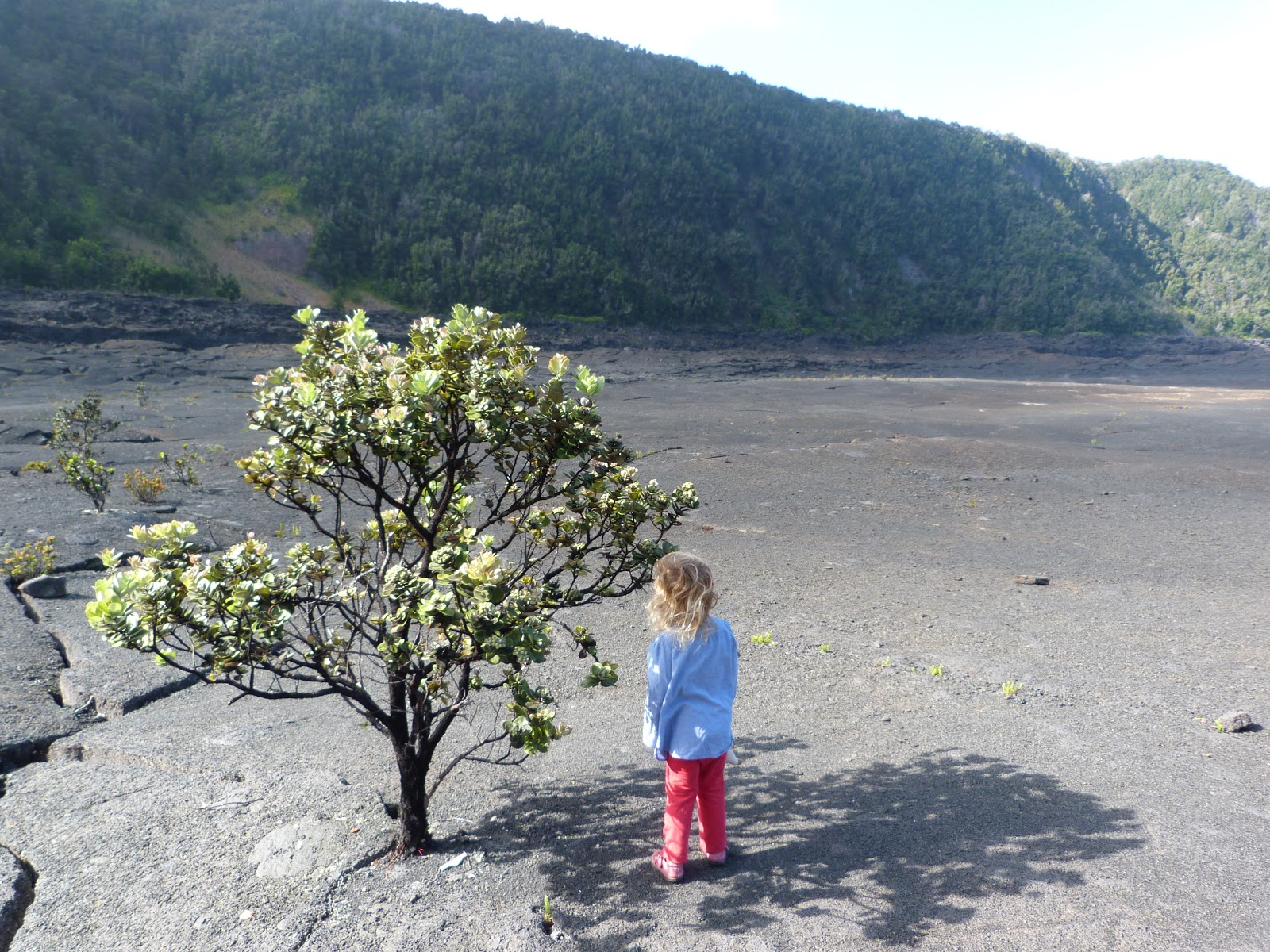
Talk about out-of-this-world. We had never seen anything like this crater floor with its black, undulating surface with trickles of steam ghosting out of fissures here and there. Follow the ahu (“stacked rocks”), said our trail guide, and if you couldn’t find those you probably shouldn’t be down there, but the way was visible from the greyish gravel trail stretching across the crater, and a dozen numbered markers.
            Our daughter was in phenomenal spirits. She had walked—no, ran—the entire downhill trail on the side of the crater, and now she struck off across the wide black floor.
It was all fun and games on the crater floor--at first. 
*
Kilauea Iki erupting in '59. 
Credit: usgs.gov
“We were continually broiled by radiant heat from the fountain and flows and were bathed in strong, at times choking, sulfur dioxide fumes,” wrote D.H. Richter, a USGS scientist in 1959. Before then, Kilauea Iki was twice as deep (800 feet) and covered with trees.
According to our trail guide from the visitor center, one night in November of 1959, the earth began rumbling. A “curtain of lava” blazed out of a crack half a mile long in the crater wall. The crater filled with a “lake of lava,” 86 million tons of molten rock. 
In the end, three days before stopping, the final surge of lava went skyward, 1900 feet (580 m), the highest surge on record in the island, and five times higher than Pu’u Pua’i (“gushing cone” in Hawaiian), ground zero at Kilauea Iki.
*
Maybe a quarter mile across the lava field, our daughter began to protest. We carried her on our backs and shoulders, our legs moving quickly as we followed the stacked rocks. Her grumpy noises became full-fledged cries, and boy did we feel stupid. She wanted to walk, so we'd set her down. Then she'd want to be carried. So far, nothing really abnormal. 
Did I mention we forgot to bring a hat with a large brim for our daughter?
“Wear my hat, Genevieve,” one parent would say.
“No! I don’t wanna!”
“I’m putting this on you whether you like it or not.”
“No, waaaaaa!
Though you can't hear her, there is sound,
a big, sad sound.

Perhaps to make us feel better, the universe sent hikers with children, though traveling in the opposite direction, and those children were around five to fifteen years old. They gave our girl sympathetic looks and us stony glances. Their parents bared teeth in hot grins, sweat dripping down their middle-aged faces.
We still had to walk through the narrow point,
 then up and around the crater rim trail.

The sun shone and though it was early October, I think the temperature at the overlook was about eighty degrees Fahrenheit. But within the crater, surrounded by black lava and steam vents, the temperature soared.

The trail was undulating to flat as it beelined across the diabolical bathtub, but once we approached Pu’u Pua’i on the far end, the trail herked up and down. The hardened lava had been smooth for most of the walk, but now it was jagged and sharp. When our daughter wanted to walk, we had to carry her for fear she might slice her feet open on a tumble.
By the time we reached the far end of Kilauea Iki, we fully regretted having dragged G-Beans on this hike. We still had to take the sunny switchback up the far side of the caldera, and walk a mile or so on the Crater Rim Trail to the parking lot.
Our daughter was pissed and would not be appeased. Her fists pounded on the top of her father’s head, mashing his hat, and my hat (which was on her head in fits and bursts) often went sailing through the air.
JRR Tolkien's inspiration for Mordor?
A funny thing happened when we approached the end of the hike. Laughter, sweet childish laughter.
“Let me down! I wanna walk!”
“No, you’re too slow. We gotta get back before you melt.”
“No! Let me down!”
Upon her insistence, our girl was placed on her feet. We were under trees now, amongst the ferns and towering ohia lehua trees. Our daughter gave a smile, and went trotting forward, ready to tell the world that (one) this three-year-old had traversed the mighty Kilauea Iki crater, and (two) she had escaped her parents.
How our daughter felt, or Kilauea Iki in '59.
Credit: USGS.gov
*
PHOTO ALBUM
What a lovely trail through the rainforest
on the edge of Kilauea Iki,
we were all thinking. 
ABOVE: On the caldera floor. Note Little One is having doubts
while Parents look stupidly eager. 

BELOW: Kitty's moment in the limelight. Note the dour expression
even on this stuffed animal. 

Look where we're gonna walk today. Now go!
The Sun, aka Eye of Sauron.
Credit: Onifaux, 2007
Respite in the shade of a lone ohia lehua tree. 
Our daughter: "No more pictures!"


A happier child looking back at the long way she came.


A total trooper by the trail's end.
                 Hawai'i Volcanoes National Park, Big Island


MORDOR!!  Credit: New Line Cinema, 2004